• De:versify – New Poetry
  • Welcome
  • About
  • Blog
  • Reviews and Comments
  • BORVO
  • Denagerie of Poems
  • The Reunion
  • Contact

Denny Bradbury Books

Denny Bradbury Books

Category Archives: History

King Alfred

17 Tuesday May 2011

Posted by dennybradburybooks in History

≈ 8 Comments

Tags

anglo saxon kings, Borvo, Denny Bradbury, healer, King Alfred, Winchester

King Alfred

By Sarah Hogan

Statue of King Alfred in Winchester - image by Ewen and Donabel

King Alfred, or Alfred the Great, ruled the House of Wessex for 18 years. He became King of Wessex in 871 and was the first King to call himself King of the Anglo Saxons.

His reign was full of battles with the Vikings, on land and sea. He defended southern parts of England from invasion from his base in Winchester. Winchester became more prominent under the Wessex kings, King Alfred was buried there and a statue of him can be found in the Hampshire town.

King Alfred is now a central character in a new book from Denny Bradbury, Borvo. It is set in Winchester and tells the story of a pagan boy who comes to the aid of the great King.

Learning and culture was said to be of great importance to King Alfred. It’s thought that he encouraged English to be used as a written language. Under his rule, the Anglo Saxon Chronicle was begun, a huge source of early English history.

King Alfred is also said to be the founder of the Royal Navy. It most likely did exist in some before him, but he took it upon himself to greatly improve ships and defences across the Wessex kingdom.

It’s recorded in the Anglo Saxon Chronicle that Alfred died in 901. Although that could not necessarily be true as many different scholars and sources contributed to the Chronicle. He was initially buried in Winchester Cathedral, but his remains were moved to Hyde Abbey in 1110. When Henry VIII ordered the dissolution of the monasteries in 1536, the Abbey was demolished and his remains have never been found.

He is Elizabeth II’s 32nd great – grandfather.

King Alfred is known as the great Anglo Saxon ruler. In Borvo, Denny Bradbury explores how this eminent King needs help from a lowly pagan boy.

To find out more about Winchester Cathedral please click here.

To purchase one of Denny’s books please click on the images below or contact Denny directly at email denisebradbury@btinternet.com.

The Reunion Denagerie of Poems by Denny Bradbury

Anglo-Saxon Healing – Potions, amulets and chants

16 Monday May 2011

Posted by dennybradburybooks in History

≈ 1 Comment

Tags

Borvo, Denny Bradbury, healers, healing powers, King Alfred

Healers

Borvo means the deity of healing

The titular character in Denny Bradbury’s latest book is named after the deity of healing, Borvo.

This teenage boy comes from a healing family and we follow his growth into maturity in the time of King Alfred.

Every settlement during this era would likely have a healer within sight.  Women, in particular, were more prone to early deaths than their male counterparts: pregnancies, miscarriages and the act of child-birth itself were all dangerous times in the life of a woman in the Anglo-Saxon era.

Archaeologists have also linked other common problems to this era: toothache, headache, earache, burns, and joint pain/bone deformities in particular – linked to the harsh life and lack of certain nutritional items in their diet.

Nowadays we would go to the local shop and buy some medication or ointment to ease our problems – during the 9th century, however, treatments required longer preparation.

Salves, poultices, and infusions would be concocted from local plants: garlic was often used to treat infection; lichens were useful in assisting the mend of broken bones; and camomile for digestion.  Nettles, watercress and fungi were also frequently used.

It was not only ‘potions’ which were used in healing – advice was given, amulets worn and chants were sung.  Stones such as amber were thought to ward off evil spirits and joint pain; emerald to aid memory; and garnet for general good health.

There was a time when historians looked back to this period of history and ‘laughed’ at the so-called medical treatments – the idea of trial and error, praying to gods and ‘hoping for the best’.

Medical manuscripts written in the age – such as ‘The Leech Book of Bald’ by Bald, a companion of King Alfred – talk of flying venoms and a variety of elves (wood elves, water elves, bright elves and dark elves).

Taken at face-value these seem irrational causes of problems.  Yet look closer and understand ‘flying venom’ to mean airborne disease and elves to be carriers of conditions from various natural sources, and you begin to see the start of medical textbooks.

Nowadays, historians take a different view on medical treatment in Anglo-Saxon times.

Aside from community healers who usually learnt their trade through knowledge handed down through family, physicians – few and far in between – were also in existence.  During this period, professional medics were named ‘laece’ or ‘leech’.

Many originated from monasteries which were appearing more and more across the ‘British’ landscape.  They were taught language, studied Greek and Latin medical texts, and sometimes grew their own supply of herbs within the monastery gardens.

In her latest book, Denny beautifully merges historically sound life in the time of King Alfred, healing treatments and attitudes in particular, with an interesting fictional read.

Reserve your copy of her book now by emailing denisebradbury@btinternet.com

Laura Scott


To purchase one of Denny’s books please click on the images below or contact Denny directly at email denisebradbury@btinternet.com.

The Reunion Denagerie of Poems by Denny Bradbury

Winchester Cathedral

09 Monday May 2011

Posted by dennybradburybooks in History

≈ 4 Comments

Tags

Borvo, Denny Bradbury, Winchester, Winchester Cathedral

Winchester Cathedral

By Sarah Hogan

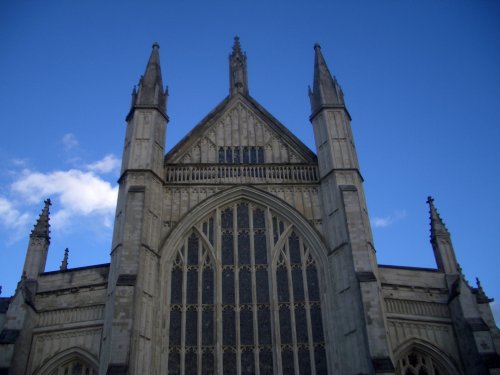
Winchester Cathedral

Winchester Cathedral - image by Dan Taylor

Winchester Cathedral is one of the largest in Europe – and the oldest. It was originally founded in 642, as a small Saxon Church.

The original cross-shaped church became known as Old Minster. Its outline can still be seen today to the north of the present Cathedral. With the town of Winchester increasing in importance, the small Church became a Cathedral with great significance. Winchester became the capital of Wessex, the most important region in England at the time. And with that the Church became the most important royal church in Anglo-Saxon England, the burial place of many West Saxon Kings.

Winchester is now the setting for a new book from Denny Bradbury. The historical significance of the town and the Cathedral plays a huge part in Borvo. The historical fiction novel tells the story of a pagan boy who comes to the aid of King Alfred.

The construction of the great Cathedral which still stands today began in 1079, said to be ordered by William the Conqueror who had already extended the royal palace of Winchester and built a castle in the capital city.

King Alfred, one of the earliest Kings of Wessex, was originally buried at the Cathedral. Many of kings were buried in the Cathedral, including King Cnut who ruled England and Denmark in the eleventh century and William II, William the Conqueror’s son. Catholic Mary Tudor, daughter of Henry VIII chose to have her wedding to Phillip of Spain at the Cathedral, after it survived the reformation.

During the reformation, the Priory of Saint Swithun, where monks had studied for years was dissolved. The Chapter House and Cloister were demolished, but the Cathedral survived.

In the early 20th century, the Cathedral was near collapse and needed extensive restoration work. It was built in a valley of the river Itchen, so due to peaty soil, the foundations were waterlogged. But the water couldn’t be held back long enough for new foundations to be built around the existing ones. So William Walker, a deep sea diver, was called in to help. He delivered bags of concrete to the foundations everyday for six years, ensuring the Cathedral’s stability.

Adding to the ancient kings buried in the Cathedral, more recently it’s become famous for the burial of an author. Jane Austen died in 1817, having published some books but not reaching a great level of fame. She lived near the Cathedral with her sister, and was buried there with just four people in attendance at her funeral. Her fame increased throughout the later 19th century, and by 1900 a memorial window was installed in the Cathedral.

Winchester Cathedral is famed for its historical significance and ties with the past. Denny Bradbury’s new novel Borvo explores how a great King can relate to a pagan boy.

Borvo will be available in June. To preorder click here.

Find out more about Winchester here.

To purchase one of Denny’s books please click on the images below or contact Denny directly at email denisebradbury@btinternet.com.
The Reunion Denagerie of Poems by Denny Bradbury

The World’s First Book

03 Tuesday May 2011

Posted by dennybradburybooks in History

≈ Leave a comment

Tags

Borvo, Denny Bradbury, history, printing press, World's first book

There are many claims for the World’s First Book – and what can actually be defined as a book. So I will be looking at the world’s first printed books.

Again, this throws up different arguments, as texts have been found with no certainty of when and how they were created.

There is a book in the British Library, ‘Diamond Sutra’ which is considered one of the earliest viable printed books, viable because it has a date, unlike others. It’s a Buddhist text, containing teachings. It was produced using the woodblock method, which requires carving every word of every page into wood, then printing it. Towards the end, it says “Reverently made for universal free distribution by Wang Jie on behalf of his two parents on the 15th of the 4th moon of the 9th year of Xiantong (11th of May 868).”

However, the Gutenberg Bible is considered by many to be the world’s first printed book. It was the first book printed with the movable printing press, kick starting a printing revolution. Johannes Guttenberg invented the moveable printing press, using oil based ink and experimented with different processes. In 1455 he printed his Guttenberg bible. This style of printing ushered in the period of modernity. We can thank Johannes Guttenberg when reading books today as his ideas form the basis of modern day printing presses. With a little help from computers and digital technology of course . Denny Bradbury’s new book Borvo, available in June, will be printed using Guttenberg’s foundation ideas.

It’s thought 180 copies of the Guttenberg bible were printed, 45 of them on Vellum and the rest on paper. 47 of these are thought to still exist, but only 21 of them are complete. The rest have pages or whole volumes missing. The British Library holds 2 complete copies, one in paper and one in Vellum. The price of a completed copy today is estimated to be in the region of £25 million pounds.

Learn about the history of poetry here.

Newer posts →

Subscribe

  • Entries (RSS)
  • Comments (RSS)

Archives

  • March 2021
  • January 2021
  • April 2020
  • February 2020
  • January 2020
  • February 2019
  • September 2018
  • April 2018
  • March 2018
  • February 2018
  • January 2018
  • December 2017
  • November 2017
  • September 2017
  • August 2017
  • June 2017
  • May 2017
  • April 2017
  • March 2017
  • January 2017
  • December 2016
  • October 2016
  • September 2016
  • August 2016
  • July 2016
  • June 2016
  • May 2016
  • April 2016
  • March 2016
  • February 2016
  • January 2016
  • December 2015
  • November 2015
  • October 2015
  • September 2015
  • August 2015
  • June 2015
  • May 2015
  • April 2015
  • March 2015
  • February 2015
  • January 2015
  • December 2014
  • November 2014
  • October 2014
  • September 2014
  • August 2014
  • July 2014
  • June 2014
  • May 2014
  • April 2014
  • March 2014
  • February 2014
  • January 2014
  • December 2013
  • November 2013
  • October 2013
  • September 2013
  • August 2013
  • July 2013
  • June 2013
  • May 2013
  • April 2013
  • March 2013
  • February 2013
  • January 2013
  • December 2012
  • November 2012
  • October 2012
  • September 2012
  • August 2012
  • July 2012
  • June 2012
  • May 2012
  • April 2012
  • March 2012
  • February 2012
  • January 2012
  • December 2011
  • November 2011
  • October 2011
  • September 2011
  • August 2011
  • July 2011
  • June 2011
  • May 2011
  • April 2011
  • March 2011

Categories

  • Denny's Diary
  • fairytales
  • Fiction
  • History
  • Literacy News
  • Misc
  • Poetry
  • Polls
  • Reviews

Meta

  • Create account
  • Log in

Latest Tweets from Denny Bradbury Books

Tweets by DennyBradbury

Blog at WordPress.com.

Privacy & Cookies: This site uses cookies. By continuing to use this website, you agree to their use.
To find out more, including how to control cookies, see here: Cookie Policy
  • Subscribe Subscribed
    • Denny Bradbury Books
    • Join 73 other subscribers
    • Already have a WordPress.com account? Log in now.
    • Denny Bradbury Books
    • Subscribe Subscribed
    • Sign up
    • Log in
    • Report this content
    • View site in Reader
    • Manage subscriptions
    • Collapse this bar
 

Loading Comments...