• De:versify – New Poetry
  • Welcome
  • About
  • Blog
  • Reviews and Comments
  • BORVO
  • Denagerie of Poems
  • The Reunion
  • Contact

Denny Bradbury Books

Denny Bradbury Books

Tag Archives: Denny Bradbury

Thomas Hardy across the atlantic

10 Tuesday May 2011

Posted by dennybradburybooks in Denny's Diary

≈ Leave a comment

Tags

Denny Bradbury, denny bradbury books, far from the madding crowd, Thomas Hardy

Thomas Hardy

How great to hear fom Rhonda in the USA. It is marvellous to be able to share a passion for something, Hardy’s writing, with people all over the world. My particular favourite was Far from the Madding Crowd. We studied it at school and I was instantly hooked and have been a fan ever since. Discovering his poetry was a revelation for me too. His love poems are rather tortured as he seemd unable to love what was within his reach, only when women were unobtainable (like his dead first wife) did he truly realise his feelings. I wonder if he was difficult to live with!

Denny Bradbury

Winchester Cathedral

09 Monday May 2011

Posted by dennybradburybooks in History

≈ 4 Comments

Tags

Borvo, Denny Bradbury, Winchester, Winchester Cathedral

Winchester Cathedral

By Sarah Hogan

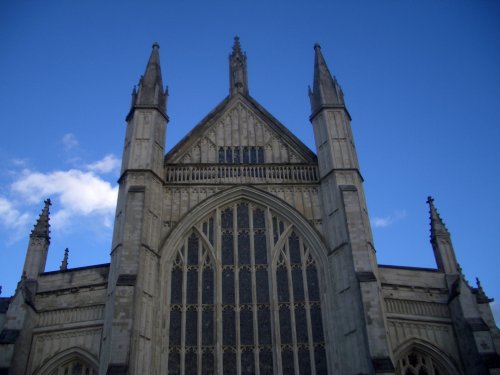
Winchester Cathedral

Winchester Cathedral - image by Dan Taylor

Winchester Cathedral is one of the largest in Europe – and the oldest. It was originally founded in 642, as a small Saxon Church.

The original cross-shaped church became known as Old Minster. Its outline can still be seen today to the north of the present Cathedral. With the town of Winchester increasing in importance, the small Church became a Cathedral with great significance. Winchester became the capital of Wessex, the most important region in England at the time. And with that the Church became the most important royal church in Anglo-Saxon England, the burial place of many West Saxon Kings.

Winchester is now the setting for a new book from Denny Bradbury. The historical significance of the town and the Cathedral plays a huge part in Borvo. The historical fiction novel tells the story of a pagan boy who comes to the aid of King Alfred.

The construction of the great Cathedral which still stands today began in 1079, said to be ordered by William the Conqueror who had already extended the royal palace of Winchester and built a castle in the capital city.

King Alfred, one of the earliest Kings of Wessex, was originally buried at the Cathedral. Many of kings were buried in the Cathedral, including King Cnut who ruled England and Denmark in the eleventh century and William II, William the Conqueror’s son. Catholic Mary Tudor, daughter of Henry VIII chose to have her wedding to Phillip of Spain at the Cathedral, after it survived the reformation.

During the reformation, the Priory of Saint Swithun, where monks had studied for years was dissolved. The Chapter House and Cloister were demolished, but the Cathedral survived.

In the early 20th century, the Cathedral was near collapse and needed extensive restoration work. It was built in a valley of the river Itchen, so due to peaty soil, the foundations were waterlogged. But the water couldn’t be held back long enough for new foundations to be built around the existing ones. So William Walker, a deep sea diver, was called in to help. He delivered bags of concrete to the foundations everyday for six years, ensuring the Cathedral’s stability.

Adding to the ancient kings buried in the Cathedral, more recently it’s become famous for the burial of an author. Jane Austen died in 1817, having published some books but not reaching a great level of fame. She lived near the Cathedral with her sister, and was buried there with just four people in attendance at her funeral. Her fame increased throughout the later 19th century, and by 1900 a memorial window was installed in the Cathedral.

Winchester Cathedral is famed for its historical significance and ties with the past. Denny Bradbury’s new novel Borvo explores how a great King can relate to a pagan boy.

Borvo will be available in June. To preorder click here.

Find out more about Winchester here.

To purchase one of Denny’s books please click on the images below or contact Denny directly at email denisebradbury@btinternet.com.

The Reunion Denagerie of Poems by Denny Bradbury

The History of Fictional Prose – Part 2: The printing press and entertainment

09 Monday May 2011

Posted by dennybradburybooks in Fiction

≈ 1 Comment

Tags

Denny Bradbury, fiction, history, History of Poetry, Poetry, William Shakespeare

History of Fictional Prose

We have been exploring the emergence of literature, and fictional prose in particular.  How ‘symbols’ and ‘pictograms’ changed to words which recorded ‘fact’ in part 1.

Tales and myths, previously handed down through generations by word of mouth, became documented.  Then civilisations started to experiment with different writing styles and we left it last time with the introduction of a writing ‘frame’ as seen in One Thousand and One Nights.

What was still lacking, however, was the first true written work of a single piece of prose fiction.

A boost was made to prose-writing in 1455 with the introduction of the printing press to Europe.  Other forms of printing had already come to existence around the world but this introduced mass printing and ensured printed material became available to a larger population, not just the privileged few.

Unlike poetry, which had rhythm and rhyme to assist in its’ recount, prose was not easily remembered and therefore needed to be written down.  The printing press ensured prose a future and more people started to experiment in the longer-style of writing, with little or no ‘structure’ as seen in verse.

William Caxton was the first to publish a book in English in the late 15th century – this was not a work of fiction but the translation of a History of Troy.  Chaucer’s Canterbury Tales and Malory’s Le Morte d’Arthur are included in the works he published in England.  Again, these are collections of tales, not a single piece of continuous prose.

During the early modern period we see the likes of William Shakespeare and Christopher Marlowe writing plays for entertainment rather than education, so fiction as we understand it nowadays was starting to take shape.

Spanish author Miguel de Cervantes had ‘The Ingenious Gentleman Don Quixote of La Mancha’ published in two parts 1605 and 1615.  It is widely regarded as turning point in fictitious writing.  Again, it is written around several ‘stories’ of his exploits but these have no relation to historical figures – genuine fiction.

Early English novelists include John Bunyan, Daniel Defoe and Jonathan Swift, all born in the 17th century.  Indeed, in many circles, Daniel Defoe is credited as being the first true English fiction novelist with his work ‘Robinson Crusoe’ (published in 1719) – a fictional autobiography.

The history of fictional prose has been a difficult one to trace.  Works we now find ‘laughable’ were believed at the time.  Imagination was not encouraged in the early years – most written material was historical or religious.  It took a few brave authors to step out of the shadow; include emotions in their work.

Then we have the second obstacle of actually writing prose.  Poetry was in existence in oral form for millennia.  This slowly became documented and verse was formed.  An extended piece of writing was a long way off when written word was first introduced.

Tales were written, then collections of stories.  Gradually the expression of writing grew.  It was not a quick process.  One thing is widely accepted – we would not have experienced the joy of novels without the invention of the printing press.

Denny Bradbury is a modern-day fiction author and poet.  ‘The Reunion’ is a fictitious novel exploring a year in the lives and emotions of five friends. She is also promoting her new novel, Borvo, which is an extraordinary historical-fiction novel around King Alfred.

To read part 1 of my article on the History of Fictional Prose click here

Laura Scott

To purchase one of Denny’s books please click on the images below or contact Denny directly at email denisebradbury@btinternet.com.

The Reunion Denagerie of Poems by Denny Bradbury

Digital books sales increase in UK

04 Wednesday May 2011

Posted by dennybradburybooks in Literacy News

≈ 1 Comment

Tags

Books, Denny Bradbury, digital books, ebooks

Sales of digital books in the UK are have quadrupled.

That’s according to new figures out from the Publishers Association.

Last year sales increased from four million pounds to sixteen million pounds.

Despite the big rise the sales still remain a small percentage of total book sales in the UK, which was just over three billion pounds.

The World’s First Book

03 Tuesday May 2011

Posted by dennybradburybooks in History

≈ Leave a comment

Tags

Borvo, Denny Bradbury, history, printing press, World's first book

There are many claims for the World’s First Book – and what can actually be defined as a book. So I will be looking at the world’s first printed books.

Again, this throws up different arguments, as texts have been found with no certainty of when and how they were created.

There is a book in the British Library, ‘Diamond Sutra’ which is considered one of the earliest viable printed books, viable because it has a date, unlike others. It’s a Buddhist text, containing teachings. It was produced using the woodblock method, which requires carving every word of every page into wood, then printing it. Towards the end, it says “Reverently made for universal free distribution by Wang Jie on behalf of his two parents on the 15th of the 4th moon of the 9th year of Xiantong (11th of May 868).”

However, the Gutenberg Bible is considered by many to be the world’s first printed book. It was the first book printed with the movable printing press, kick starting a printing revolution. Johannes Guttenberg invented the moveable printing press, using oil based ink and experimented with different processes. In 1455 he printed his Guttenberg bible. This style of printing ushered in the period of modernity. We can thank Johannes Guttenberg when reading books today as his ideas form the basis of modern day printing presses. With a little help from computers and digital technology of course . Denny Bradbury’s new book Borvo, available in June, will be printed using Guttenberg’s foundation ideas.

It’s thought 180 copies of the Guttenberg bible were printed, 45 of them on Vellum and the rest on paper. 47 of these are thought to still exist, but only 21 of them are complete. The rest have pages or whole volumes missing. The British Library holds 2 complete copies, one in paper and one in Vellum. The price of a completed copy today is estimated to be in the region of £25 million pounds.

Learn about the history of poetry here.

← Older posts
Newer posts →

Subscribe

  • Entries (RSS)
  • Comments (RSS)

Archives

  • March 2021
  • January 2021
  • April 2020
  • February 2020
  • January 2020
  • February 2019
  • September 2018
  • April 2018
  • March 2018
  • February 2018
  • January 2018
  • December 2017
  • November 2017
  • September 2017
  • August 2017
  • June 2017
  • May 2017
  • April 2017
  • March 2017
  • January 2017
  • December 2016
  • October 2016
  • September 2016
  • August 2016
  • July 2016
  • June 2016
  • May 2016
  • April 2016
  • March 2016
  • February 2016
  • January 2016
  • December 2015
  • November 2015
  • October 2015
  • September 2015
  • August 2015
  • June 2015
  • May 2015
  • April 2015
  • March 2015
  • February 2015
  • January 2015
  • December 2014
  • November 2014
  • October 2014
  • September 2014
  • August 2014
  • July 2014
  • June 2014
  • May 2014
  • April 2014
  • March 2014
  • February 2014
  • January 2014
  • December 2013
  • November 2013
  • October 2013
  • September 2013
  • August 2013
  • July 2013
  • June 2013
  • May 2013
  • April 2013
  • March 2013
  • February 2013
  • January 2013
  • December 2012
  • November 2012
  • October 2012
  • September 2012
  • August 2012
  • July 2012
  • June 2012
  • May 2012
  • April 2012
  • March 2012
  • February 2012
  • January 2012
  • December 2011
  • November 2011
  • October 2011
  • September 2011
  • August 2011
  • July 2011
  • June 2011
  • May 2011
  • April 2011
  • March 2011

Categories

  • Denny's Diary
  • fairytales
  • Fiction
  • History
  • Literacy News
  • Misc
  • Poetry
  • Polls
  • Reviews

Meta

  • Create account
  • Log in

Latest Tweets from Denny Bradbury Books

Tweets by DennyBradbury

Blog at WordPress.com.

Privacy & Cookies: This site uses cookies. By continuing to use this website, you agree to their use.
To find out more, including how to control cookies, see here: Cookie Policy
  • Subscribe Subscribed
    • Denny Bradbury Books
    • Join 73 other subscribers
    • Already have a WordPress.com account? Log in now.
    • Denny Bradbury Books
    • Subscribe Subscribed
    • Sign up
    • Log in
    • Report this content
    • View site in Reader
    • Manage subscriptions
    • Collapse this bar
 

Loading Comments...