Tags
Borvo, danes, Denny Bradbury, invaders, King Alfred, pagan, viking
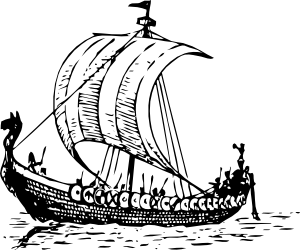 Viking in ‘old Norse’ translates as ‘pirate raid’ and for the Anglo-Saxons that is what it must have felt like.
Warriors from Denmark, Norway and Sweden crossed the seas in their long ships in search of treasure or a new place to settle.
The Anglo-Saxon Chronicle recalls the first invasion by these people in the South-East of England in AD787. Whilst Anglo-Saxons tended to call these invaders ‘Danes’ the Norwegians who headed to Scotland and the North of England were in fact ‘Norsemen’.
Initially it is felt these attacks were merely ‘raids’. Attacks on monasteries were frequent – a wealth of food, cattle and treasures but with no resistance. In the mid-9th century these invaders started to settle with intent on conquest.
Denny Bradbury’s book ‘Borvo’ is set during the time of King Alfred the Great. It focuses on a young pagan boy growing up in the time of the King’s defence of his realm against these ‘Danish invaders’.
Alfred is acknowledged as king of the only independent English kingdom, having successfully resisted invasion time and again.
Yet what was it he faced on the battlefields?
The Danes would be armed with spears, axes or swords. Spears were commonplace and used for thrusting or throwing. Indeed, a battle was prone to start with a defensive line of warriors hurling spears 2-3 metres in length to gain an early advantage.
Axes were a favourite in close-quarter fighting, although the famed double-handed axe did not come into existence until the latter years of Danish occupation.
Swords were rare due to their cost and anyone fighting with such a weapon was likely to hold a high status within the Danes.
Whatever their status, all warriors would have a small side-knife for general use as well as battle if absolutely necessary.
For defence, these invaders would hold circular shields approximately 1 meter wide.
Kite-shaped shields which gave better defence to the legs, were not invented until the turn of the first millennium.
Long tunics of chain mail were also worn – ‘byrnies’. Again, similar to swords, these were expensive to make and likely to have only been worn by high-ranking officials.
Reindeer hide is thought to have been worn for protection, absorbing some of the impact from weapons.
The famed two-horned helmet of the ‘Vikings’ is, however, unlikely. Any helmets were expensive to produce and again would only have been worn by someone with the correct status.
These warriors trained from a young age in the art of weaponry, through hunting and raiding. For many, it was an ambition to become a celebrated warrior and so they would volunteer for battle in the hopes of winning prized weapons and the status that came with the reward.
In fact it was a requirement for all ‘free’ Scandinavians to own weapons – the metalwork, designs and style dictated their status. They would travel to far-off lands on long-ships which had a shallow draft allowing for deeper incursions via river.
Vary rarely were these warriors seen on horseback – they were not a means to enter battle but sometimes used to assist travel if the distance was great.
The battle lines were not those of professional, organised soldiers but bands of ‘brothers’ – friends and warriors who would fight side-by-side. Numbers varied depending on the battle, but could be as many as 7000. A group of around 30 would surround the main leader of the army as a ‘last defence’.
The ‘beserks’ were a feared group of the invaders, known for getting so hyper for battle that it is believed they did not feel pain. Their belief in their god of war ‘Odin’ for protection meant these fearless few tended to wear only bear skins for armour.
Read how the Danes were perceived by the Anglo-Saxons in Denny Bradbury’s book Borvo.
Laura Scott
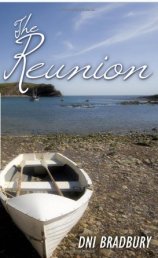
Denny Bradbury’s latest novel ‘Borvo‘ will be available in both print and as an e-book.
To purchase one of Denny’s books please click on the images below or contact Denny directly at email denisebradbury@btinternet.com.


 When I first thought of writing about Borvo he was going to be another in a list of short stories about the magic of water and how we often feel a deep need to be by it. Seaside, river, waterfall or lake all seem to offer a link to nature and inner calm, perhaps even a feeling of belonging to something greater than we will ever be able to express adequately. The young Borvo felt this and so when I began the process of writing his story he took over and in the end he led me on a journey that was greater than I first had in mind. I knew where he was going but for a while didn’t know how he was going to get there. The inspiration was enhanced by an early visit to Shaftesbury Abbey while I was a student as Bristol University. The place spoke to me and so, years later, when Borvo came to me it seemed natural to make it part of his story.
 Ever since I was introduced to her writing I have been intrigued by Mother Julian’s life style as an anchorite and also by the wisdom within her texts. Her most famously quoted saying is of course, ‘All shall be well, all shall be well, all manner of things shall be well.’ That seems to me to be our modern interpretation on a more difficult theme. One translation gives a more subtle and consequently more difficult offering, she feels that god has told her, ‘I will make all things well, I shall make all things well, I may make all things well; and you shall see for yourself that all things shall be well.’ However we have to stretch for the deeper understanding I feel that there is an optimism in the whole passage that gives comfort through some darker times.
 Denny Bradbury Books