• De:versify – New Poetry
  • Welcome
  • About
  • Blog
  • Reviews and Comments
  • BORVO
  • Denagerie of Poems
  • The Reunion
  • Contact

Denny Bradbury Books

Denny Bradbury Books

Tag Archives: Borvo

E-books – A popular way to read

24 Friday Jun 2011

Posted by dennybradburybooks in Literacy News, Misc

≈ 1 Comment

Tags

Are e-books popular, Borvo, Denny Bradbury, ebooks, literature, reading, What are the pro's and con's of e-books, what is the future of printed books?

The popularity of e-booksAs the first self-published author to sell one million e-books is named (American writer sells a million), we explore the popularity of these paperless documents.

The concept of e-books is not a recent phenomenon.  Indeed, in 1971 Michael S. Hart launched ‘Project Gutenberg’.  Its aim was to archive works digitally and therefore allow a wider-distribution of the books.  There are now over 34,000 items digitally stored by this project.

As the decades wore on, we saw the introduction of books on CD-ROM; available as full texts online; and eventually the download era woke up to the prospect that more than music and movies might be popular.

It is not only printed books which are available as e-books.  Authors are now starting to write specifically for the e-book market, bypassing the expense of hard-print publications.

In recent articles (Bloomsbury reports big rise in e-book sales, Digital book sales increase in UK ) we have already noticed the increasing desire to buy reading material in e-book format.

With the trend of modern life to be sat in front on a computer screen; carry smartphones and keep on the move with limited baggage, it really is no wonder that more and more people are turning to electronic reading.

E-readers are continually being developed and redeveloped to ensure maximum efficiency – larger screen sizes, lighter weight, strong textual colours; anti-glare systems, water/shock/dirt-proof: promotions pushing their suitability in different situations  ‘great for holiday travel’, ‘ideal for those intense commutes’…

Many campaigns are underway to introduce children to the love of reading (Duchess of Cornwall promotes reading, New reading project to help children in London) – what better way than to mix English Literature with the technological world they love to be part of?

E-books are more and more becoming the preferred choice of ‘book’.

Yet what are the arguments against them?

For those of use who are nostalgic, we miss the bulk of the book, the feel of paper between our fingers and the ability to see and indeed feel our progress through a book – a screen informing us we have completed 37% of the book is not the same as turning individual pages.

Paper books are also a way of slowing down the pace of life, allowing us to step away from the digital world in which we now live.

We stare at screens at work, why would we then want to stare up close at another screen?

Despite the increasing popularity of electronic readers, will hard-copy books ever be replaced?  The answer, for the present, is no.

Written word has been documented over the millenia on stone, wood, paper, ceramics – and many of their writings are still legible today.  Computer technology in comparison has been around for an insignificant amount of time.

We do not know how long this current phase will last.  I, for one, will continue to use both online and hard-based means of documentation.

According to the online Oxford Dictionary a book is ‘a written or printed work consisting of pages glued or sewn together along one side and bound in covers’.

For how much longer will this definition stand?

Laura Scott

Denny Bradbury’s latest novel ‘Borvo‘ will be available in both print and as an e-book.

To purchase one of Denny’s books please click on the images below or contact Denny directly at email denisebradbury@btinternet.com.
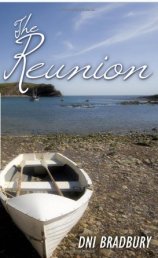
The Reunion Denagerie of Poems by Denny Bradbury

A History of Christianity Part II.

20 Monday Jun 2011

Posted by dennybradburybooks in History

≈ 1 Comment

Tags

beliefs, Borvo, Christianity, Denny Bradbury, King Alfred, Paganism, religion

Christianity and Borvo

Christianity and the church are central themes in "Borvo"

As mentioned in Part I, Christianity is the world’s largest religion.  It has the greatest number of followers with approximately two billion around the world and forty million in the UK alone, with many different types of Christianity being practised. It is a belief system that over the years has had immense cultural and political consequence across nations, with major divisions occurring between Western Christianity – itself divided into Roman Catholicism and Protestantism – and Orthodox Christianity, and from the 16th and 17th centuries onwards it was a religion that developed missionary movements which established its beliefs throughout the world.

Central to Christian beliefs and practices is the Bible, split into the New Testament that details the life of Jesus and the Early Church and the Old Testament which is identical to the scriptures that Jesus would have referred to as a practising Jew.  Other important texts are the Creeds: the Apostles ’ Creed and the Nicene Creed which are both summaries of the beliefs formulated in the early years of Christianity.

In 1054, a formal division opened up between Western Catholicism and Eastern Orthodoxy, caused by Christianity spreading throughout the world, with different groups disagreeing over different aspects, thereby causing the Church to begin to split into various branches but prior to this, as mentioned in Part I, it was the Pagan beliefs that were the first direct conflict with Christian values.

Just as in the famous poem “Beowulf” where the two sets of beliefs are accommodated, with Paganism promoting the earthly good and Christianity asserting heavenly salvation, Denny Bradbury also combines the pagan values of bravery and loyalty through her pagan hero Borvo in her soon to be released second novel of the same name. She combines the healing powers of the young boy with the Christian values of forgiveness and peace and a spiritual life through her portrayal of King Alfred, fighting to introduce Christianity to an England being invaded by the marauding Pagan Danes, illustrating how the pagan belief system and Christian traditions are alike in some respects.

Like the book “The Mists of Avalon” released in 1983, in which the chief character is a Pagan Priestess whose half brother is King Alfred, Denny Bradbury also has a main protagonist from a Pagan background finding his way at a time when patriarchal Christianity is taking hold.

The Church, Royalty and ideas collide in the new book "Borvo"

The Church, Royalty and ideas collide in the new book "Borvo"

Nowadays, Christianity is responsible for the way our society is organised and for the way thousands of people currently live.  Its influence can be found in laws, economics, politics, art, music, literature, and architecture, to name just a few and it is a religion split into Roman Catholics, Orthodox, Protestant, Anglican, The Free Churches and Pentecostal, with its impact is felt across all manner of fundamental areas of life such as Human Rights, Marriage and Family, the Governing of countries, and the emergence of scientific laws .

As King Alfred himself showed through his dedication to bringing the written word to his subjects, regardless of class, great emphasis is placed on education through the beliefs of Christianity.

Historian J.M.Roberts, from the book “What’s So Great About Christianity?” by Dinesh D’Souza writes: “We could none of us today be what we are if a handful of Jews nearly two thousand years ago had not believed that they had known a great teacher, seen him crucified, dead  and buried and then rise again”.

Elizabeth Bridgefield

To purchase one of Denny’s books please click on the images below or contact Denny directly at email denisebradbury@btinternet.com.

The Reunion Denagerie of Poems by Denny Bradbury

Wantage

15 Wednesday Jun 2011

Posted by dennybradburybooks in History

≈ Leave a comment

Tags

Borvo, Denny Bradbury, historical significance, history, Oxfordshire, pagan, Vale of Whitehorse, Wantage

Wantage


The statue of King Alfred in Wantage - by Colin Smith

Wantage is a small market town in Oxfordshire – best known for being the birth place of King Alfred.

Its history can be traced back to Roman times, there was a small settlement there.

King Alfred was born in the royal palace in the 9th century, around the year 849. In 1877 a statue of King Alfred was commissioned by Lord Wantage. It was created by Count Gleichen, a famous sculptor at the time. The marble statue still stands in the market place. King Alfred’s legacy remains in the town with schools and pubs bearing his name.

Wantage and King Alfred appear in a new book from Denny Bradbury. Combining the rich history of Wantage and the legend of King Alfred, Denny has created a story of a peasant boy who comes to the aid of the king. Borvo looks out how a great King can ever be helped by a young boy.

Wantage is situated in the Vale of White Horse, considered to be a prime area for horse racing. Many of its village’s house stables and gallops can be found at Black Bushes.

Wantage also appears in the Doomsday book, with its value stated as £61. At the time it was owned by the monarch, but it’s thought it was given to the Earl of Albemarle in 1140.

In Borvo Denny Bradbury explores the relationship between a great King and a young pagan healer. The historical significance of towns like Wantage play a huge part in the novel.

To purchase one of Denny’s books please click on the images below or contact Denny directly at email denisebradbury@btinternet.com.
The Reunion Denagerie of Poems by Denny Bradbury

Monastic Life – Servitude and Prayer

13 Monday Jun 2011

Posted by dennybradburybooks in History, Misc

≈ 1 Comment

Tags

Borvo, Christianity, Denny Bradbury, How to be a monk?, King Alfred, monastery, monk, What it takes to be a monk? why did people become monks in medieval times?, Why do monks take a vow of silence?, Winchester

In Denny Bradbury’s new book ‘Borvo‘ her main character attends a monastery in Winchester during the Anglo-Saxon era.

We have already explored the progression of a new recruit from postulant to novice (Monastic Life – From Postulant to Monk), also looking into the clothing that they wear and symbolic significance  (Monastic Life – A ‘habit’ of a lifetime).

Now we will study the daily practices and ask why anyone would choose to leave their loved-ones for a life of strict rule.

Monasteries around the time of King Alfred followed Benedictine rule – a strict regime of prayer, divine reading, and manual labour.

The Liturgy of the Hours was an official set of daily prayers.  They consisted mainly of psalms with hymns and readings.

Traditionally it was an 8-hour set routine:

  • Matins – overnight/midnight
  • Lauds – Dawn or 3am
  • Prime – 6am
  • Terce – 9am
  • Sext – Noon
  • None – 3pm
  • Vespers – 6pm
  • Compline – 9pm

Monks who were ordained in Holy Orders to carry on the teaching i.e. priests were ‘choir monks’.  They had to recite the Divine Office daily in choir which was in Latin.  Their life within the enclave consisted of prayer, divine office and mass.

‘Lay brothers’ was the term associated with those not part of the Holy Orders, monks who did not involve themselves in spreading the word of God.  They provided the material needs of the community i.e. growing food, preparing meals and maintaining the grounds.

Those who could not read Latin learnt The Lords Prayer and Hail Mary and recited those up to 150 times a day.

Secular clergymen and lay brothers had ‘shorter’ prayer routines to fit in with their different lifestyles.

The vow of silence is found in many monasteries however not all orders practised strict silence.  Some had a ‘silent period’ overnight; others would only talk when it was deemed necessary to fulfil their duties.

But why would you leave your families and villages, choosing to sacrifice your independent life for one of servitude and hard labour?

As many would have you believe at the time, they went to monasteries purely to find God and live a good existence.  Of course we cannot deny that some people did sacrifice their freedoms to be closer to their Lord.

What we cannot forget, however, is that monasteries were centres of knowledge and learning, sometimes the only places for scholarship and learning in Europe.  Many contained big libraries including important ancient texts.  The copying of these texts formed a large part of the monks’ life.

Laura Scott

To purchase one of Denny’s books please click on the images below or contact Denny directly at email denisebradbury@btinternet.com.
The Reunion Denagerie of Poems by Denny Bradbury

Monastic Life – The ‘habit’ of a lifetime

08 Wednesday Jun 2011

Posted by dennybradburybooks in History

≈ Leave a comment

Tags

Borvo, Christianity, Denny Bradbury, How to be a medieval monk?, King Alfred, monks, The history of monks?, What did they wear under their habit?, Why did different monks wear different colours?, Why did monks shave their heads?, Winchester

St. Benedict - founder of the Benedictine Monks

Last time we looked at the path a new recruit to religious life must walk – trialing life as a postulant, then entering training as a novice, being permitted to make his solemn or permanent vows (Monastic Life – From Postulant to Monk).

We are now going to look into more detail about the clothing worn.

The monks’ clothing is called the ‘habit’.  It is made up of several different layers.

When the postulant decided to start his proper training as a ‘novice’ he would have been supplied with two tunics, a scapula for work, stockings and shoes.

The two tunics enable him to work and sleep in one whilst the other is being washed.  They were often ankle-length and tied at the middle by cloth or leather belt.

Over the tunic, a monk would wear a scapula.  This was a long wide piece of woolen cloth worn over the shoulders, with a hole for head.  This garment was secured at the front.  The scapula signified ‘obedience’.

The colours varied between orders.  The Benedictine Monks, which were practicing during the period of King Alfred (the setting of Denny Bradbury’s book ‘Borvo’), started out wearing white or grey habits – the colour of un-dyed wool.

In later years, they dyed their clothing black, and became known as ‘the Black Monks’.

Other orders, such as Cistercian and Carthusian, wore greyish-white or brown.

After taking their solemn vows, monks were issued with two cowls (hoods).  These highlighted the fact they had given their allegiance to God.

Some monks would also wear a cross and chain over their scapula, others would instigate suffering and self-punishment by wearing hair-shirts under their tunics.

Another part of ‘dress’ associated with monks was the tonsure – the shaved head.  It was often the preference of the monk as to how shaved the head would be.

All of these items helped the monks to focus on God and set them out from the rest of the people on their travels.

Next time, we explore the daily routine of life within a monastery and ask why people would give up freedoms in the pursuit of monastic life.

Laura Scott

To purchase one of Denny’s books please click on the images below or contact Denny directly at email denisebradbury@btinternet.com.
The Reunion Denagerie of Poems by Denny Bradbury

← Older posts
Newer posts →

Subscribe

  • Entries (RSS)
  • Comments (RSS)

Archives

  • March 2021
  • January 2021
  • April 2020
  • February 2020
  • January 2020
  • February 2019
  • September 2018
  • April 2018
  • March 2018
  • February 2018
  • January 2018
  • December 2017
  • November 2017
  • September 2017
  • August 2017
  • June 2017
  • May 2017
  • April 2017
  • March 2017
  • January 2017
  • December 2016
  • October 2016
  • September 2016
  • August 2016
  • July 2016
  • June 2016
  • May 2016
  • April 2016
  • March 2016
  • February 2016
  • January 2016
  • December 2015
  • November 2015
  • October 2015
  • September 2015
  • August 2015
  • June 2015
  • May 2015
  • April 2015
  • March 2015
  • February 2015
  • January 2015
  • December 2014
  • November 2014
  • October 2014
  • September 2014
  • August 2014
  • July 2014
  • June 2014
  • May 2014
  • April 2014
  • March 2014
  • February 2014
  • January 2014
  • December 2013
  • November 2013
  • October 2013
  • September 2013
  • August 2013
  • July 2013
  • June 2013
  • May 2013
  • April 2013
  • March 2013
  • February 2013
  • January 2013
  • December 2012
  • November 2012
  • October 2012
  • September 2012
  • August 2012
  • July 2012
  • June 2012
  • May 2012
  • April 2012
  • March 2012
  • February 2012
  • January 2012
  • December 2011
  • November 2011
  • October 2011
  • September 2011
  • August 2011
  • July 2011
  • June 2011
  • May 2011
  • April 2011
  • March 2011

Categories

  • Denny's Diary
  • fairytales
  • Fiction
  • History
  • Literacy News
  • Misc
  • Poetry
  • Polls
  • Reviews

Meta

  • Create account
  • Log in

Latest Tweets from Denny Bradbury Books

Tweets by DennyBradbury

Create a free website or blog at WordPress.com.

Privacy & Cookies: This site uses cookies. By continuing to use this website, you agree to their use.
To find out more, including how to control cookies, see here: Cookie Policy
  • Subscribe Subscribed
    • Denny Bradbury Books
    • Join 73 other subscribers
    • Already have a WordPress.com account? Log in now.
    • Denny Bradbury Books
    • Subscribe Subscribed
    • Sign up
    • Log in
    • Report this content
    • View site in Reader
    • Manage subscriptions
    • Collapse this bar
 

Loading Comments...